Aero Hand Open preprint describes a simulation-ready tendon-driven hand
The Aero Hand Open preprint says it releases a tendon-driven hand design alongside simulation, actuation-mapping, reinforcement-learning, and deployment resources. Its reported no-fine-tuning deployment workflow has not been independently verified in the supplied evidence.
This edition passed Imananq's enhanced publication checks. Some material claims remain explicitly attributed to official or company sources because no independent source is currently bound to this edition. The engine continues checking approved sources and will add corroboration only through a new edition that passes the full gate.
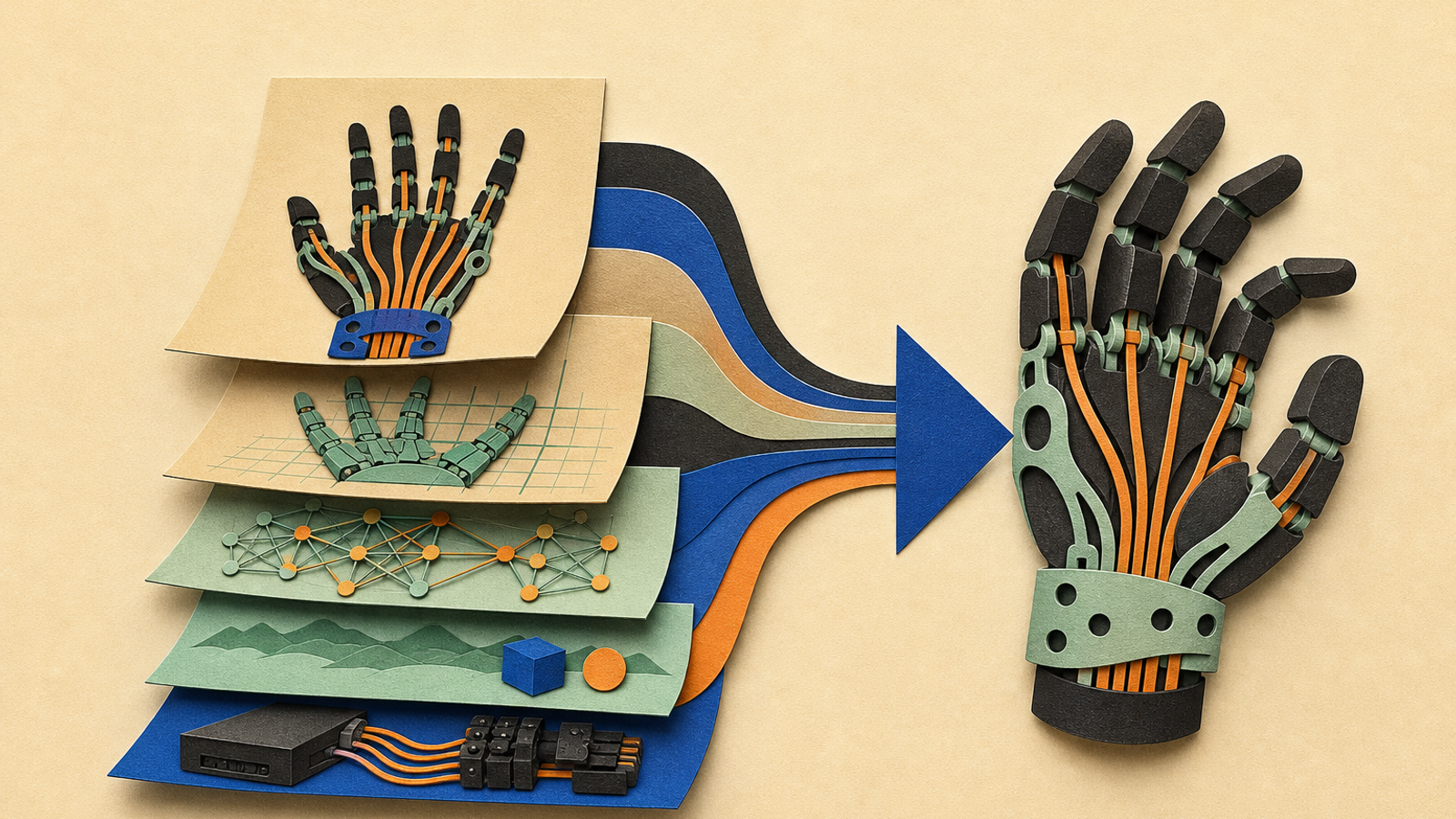
A new arXiv preprint describes Aero Hand Open, a tendon-driven anthropomorphic robotic hand intended for simulation-based dexterous-manipulation research. Its authors say they are releasing a mechanical design and a supporting simulation-to-deployment package, but the supplied record does not independently validate the system or provide the underlying release links. [1]
01
02
Record type
The work is listed on arXiv as a version-one preprint, rather than as peer-reviewed research in the supplied evidence.Submission date
The arXiv record shows version 1 was submitted on 28 August 2026.Released components claimed
Authors say the package includes design, simulation, actuation mapping, training, and deployment materials.Reported policy path
Authors say policies can be trained in simulation and deployed on the hand without fine-tuning or state estimation.Summary of what the preprint record establishes and what its authors report.
03
What the authors say they release
Nan Wang and seven coauthors introduced Aero Hand Open in an arXiv version-one submission dated 28 August 2026. They describe it as a simulation-ready, tendon-driven hand and say the release covers the hand’s mechanical design, a simulation model, an identified mapping between the model and motor commands, a training environment, and deployment software. [1]
The preprint attributes a specific modelling goal to its simulator: representing the hand’s cable transmission. The authors also say the actuation map works in both directions and accounts for three-way thumb coupling. Those are descriptions and claims from the authors, not independently established measurements in the supplied material. [1]
- Mechanical design
- Simulation model
- Identified bidirectional actuation mapping
- Reinforcement-learning training environment
- Deployment stack
04
Why the simulation component is central
The abstract frames tendon-driven construction as a trade-off. It says routing force through cables can avoid placing a motor inside every driven joint and can allow a motor to drive several joints. At the same time, the authors say that the resulting underactuated transmission is difficult to represent in simulation and means joints sharing a cable are not independently controllable. [1]
For researchers assessing the project, the relevant question is therefore not only whether a hand model is available, but whether the released simulator, actuation mapping, and training setup are accessible and sufficiently documented for a target task. The supplied record does not answer those implementation questions. [1]
- Tendon routing can leave actuators outside joints.
- A single cable can drive multiple joints.
- That underactuation also makes simulation and independent joint control more difficult, according to the abstract.
05
Deployment claim remains unverified
The authors say their reinforcement-learning package can train policies entirely in simulation and then run them on the hand without fine-tuning or state estimation. This is the preprint’s stated sim-to-real result. [1]
The supplied abstract does not report which tasks were evaluated, how hardware tests were conducted, what performance was measured, or how the claimed workflow compares with alternatives. Readers should regard the deployment statement as an attributed preprint claim rather than an independently confirmed capability. [1]
- Claimed: training entirely in simulation.
- Claimed: operation on the physical hand without fine-tuning.
- Claimed: no state estimation required.
- Not established here: task outcomes, metrics, test setup, or independent replication.
06
Source and status
The primary source is the arXiv record for “Aero Hand Open: A Simulation-Ready Tendon-Driven Hand for Dexterous Manipulation Learning,” authored by Nan Wang and seven coauthors. The record identifies the work as a version-one preprint submitted on 28 August 2026. [1]
The record lists a project page, but the supplied evidence does not acquire or verify resources hosted there. It also does not establish a publication venue, peer-review outcome, license, or independent assessment. [1]
- Primary record: arXiv:2608.28578v1
- Primary link: https://arxiv.org/abs/2608.28578v1
07
What to check before reuse
The arXiv record describes the components but does not provide acquired download links, licensing terms, or evaluation detail in the supplied evidence.
- 01
Use the arXiv record to locate the paper and its listed project page before relying on any component.
- 02
Confirm where each promised file or codebase is hosted and read its licence before reuse.
- 03
Treat the no-fine-tuning and no-state-estimation result as an author claim until task metrics, hardware methods, and independent evaluation are available.
08
Limits of this edition
This is an arXiv preprint, not evidence of peer review or independent validation. [1]
The supplied record does not include acquired links to the stated mechanical files, simulation model, training environment, or deployment stack. [1]
No licence for reuse is stated in the supplied evidence. [1]
The supplied abstract provides no task metrics, hardware-evaluation methods, or quantitative results for the reported sim-to-real workflow. [1]
SRC
Source desk
Direct links to the material behind this selection. Seeing the source matters as much as reading the synthesis.
Keep exploring

1 Sept 2026
Draft paper argues some intended meaning cannot be recovered from text alone
An arXiv draft by Emily Cheng and Ryan Cotterell proposes information-theoretic limits on recovering intended meaning from text-derived representations. The authors argue that some ambiguity can only be resolved with extralinguistic context, and they report supporting experiments. The record establishes neither peer review nor enough methodological detail to judge the theory’s practical scope. [1]

1 Sept 2026
Preprint proposes a size-and-weight limit for synthetic data in inference
The preprint proposes learning a boundary for how many synthetic observations to add and how heavily to weight them. The authors say configurations at or below that boundary receive a finite-sample coverage guarantee, and report encouraging survey-augmentation experiments. The record does not establish peer review, underlying assumptions, or detailed experimental evidence. [1]
1 Sept 2026
Preprint examines how speech-recognition errors can affect embodied-AI safety
The authors of an arXiv preprint report that simulated speech-recognition errors can make some voice-controlled embodied-AI safety failures more likely in their benchmark evaluations. They also report inconsistent benefits from automatic correction. Detailed methods and independent verification are not supplied.