Preprint proposes a “social harness” for multi-agent AI interactions
The authors of a September 2026 arXiv preprint argue that multi-agent AI systems need a “social harness” for interactions among agents, alongside each agent's personal harness. They report experiments suggesting current tools can fail across trust boundaries and propose layers for prevention, runtime message checks, and later investigation. The available evidence is limited to the preprint record and abstract. [1]
This edition passed Imananq's enhanced publication checks. Some material claims remain explicitly attributed to official or company sources because no independent source is currently bound to this edition. The engine continues checking approved sources and will add corroboration only through a new edition that passes the full gate.
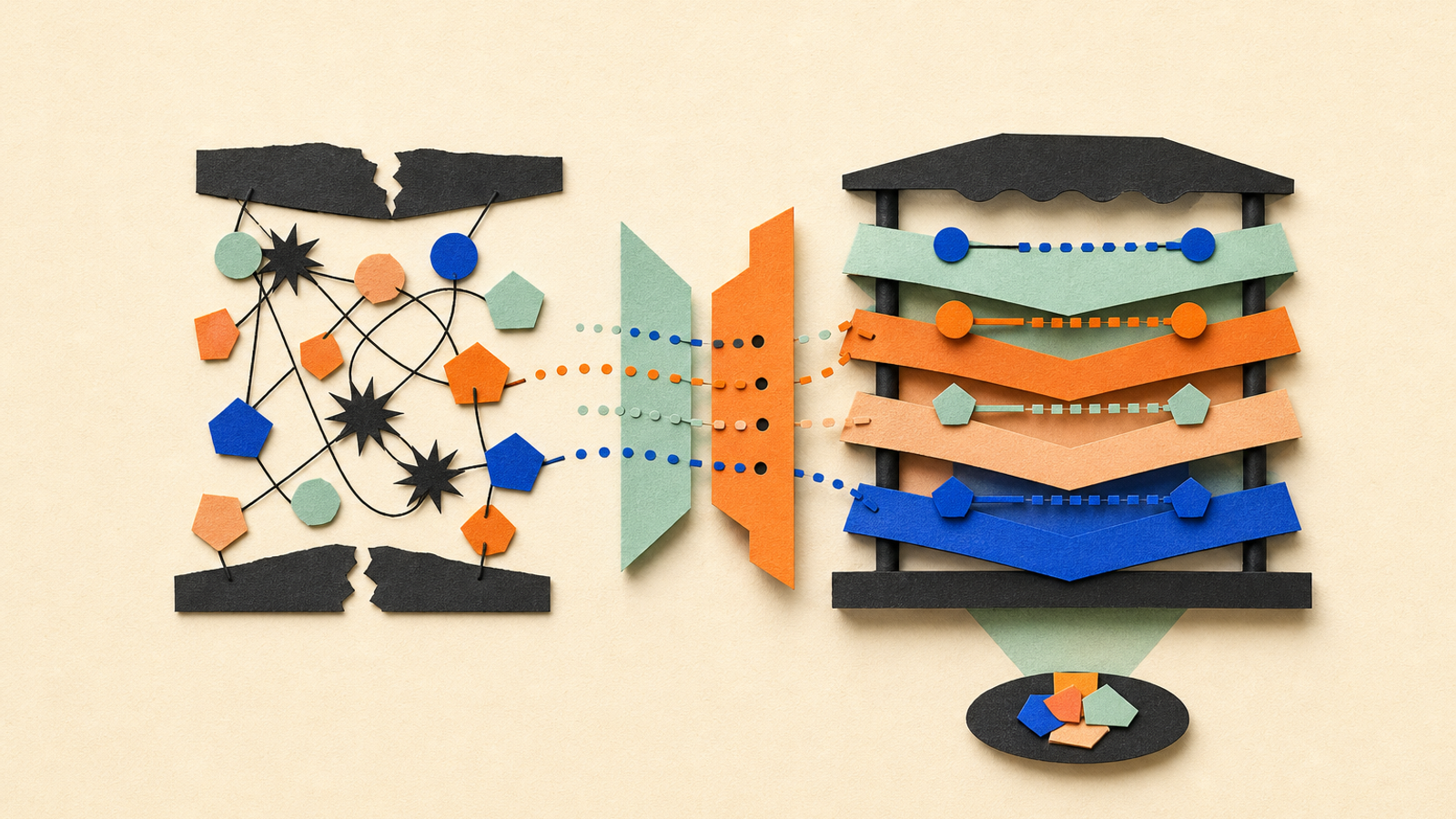
An arXiv preprint argues that safeguards focused on individual AI agents may not be enough when autonomous agents coordinate across trust boundaries. Its authors propose a separate, layered “social harness” for the interactions among agents. [1]
01
What we know now
- 01
[1] arXiv record and abstract for “Agentic Societies Need a Social Harness,” version 1, submitted 15 September 2026: https://arxiv.org/abs/2609.17527v1.
- 02
The arXiv record establishes submission metadata and the abstract's author-attributed claims; it does not establish peer review, replication, or independent validation.
02
Publication status
The work is listed as arXiv version 1. The supplied record does not establish peer review.Scope of proposed safeguard
The authors distinguish a social harness for inter-agent interactions from a personal harness for an agent's private context and principal-facing communication.Stated architecture goals
The abstract names prevention of some failures, runtime detection of invalid messages, and support for later investigation and consequences.A high-level distinction presented in the paper's abstract, not a validated implementation standard.
03
What was published
The paper defines an “agentic society” as AI agents coordinating autonomously across trust boundaries for different principals whose objectives may not fully align. This is a preprint record, not evidence of peer review or independent validation. [1]
- The record lists the paper as “Agentic Societies Need a Social Harness,” authored by Tapan Chugh, Vidushi Singh, Krish Jain, Arvind Krishnamurthy, and Ratul Mahajan.
- It was submitted to arXiv as version 1 on 15 September 2026 and is listed under Multiagent Systems, Artificial Intelligence, and Networking and Internet Architecture.
04
What problem the authors report
These are findings reported in the abstract, but the supplied material does not include the underlying experimental design or results. Readers cannot assess from this record how broadly the findings apply, which systems were tested, or how large the effects were. [1]
- The authors say existing harnesses and messaging primitives can leave even honest, competent agents unable to reach satisfactory outcomes.
- They further report that faulty or malicious agents can stall collaboration, influence outcomes, or pursue harmful goals by exploiting communication vulnerabilities.
05
What the proposed social harness is
The proposal shifts attention from safeguards around a single agent to rules and mechanisms governing communication among multiple agents. The abstract does not specify a concrete protocol, implementation, or proof that the architecture achieves its goals, so these capabilities should be understood as the authors' stated aims rather than established outcomes. [1]
- A personal harness, in the authors' framing, manages an agent's private context and communication with its principal.
- A proposed social harness would cover interaction among agents.
- The proposed layered architecture is intended to prevent some classes of failure, enable runtime detection of invalid messages, and support post-facto investigation and consequences.
06
Why the distinction may matter
For researchers and developers studying multi-agent systems, the paper highlights a question that can be missed when assessment centers on a single model or agent: whether the communication layer itself creates distinct failure modes. The paper's contribution, based on the available record, is a proposed framework and author-reported experimental motivation, not a verified safeguard standard. [1]
- The preprint offers a vocabulary for separating agent-level controls from interaction-level controls.
- It does not establish that the proposed architecture works in production systems or outperforms other approaches.
07
What readers can take from the preprint
The paper is a conceptual and experimental starting point rather than an implementation guide. Teams evaluating multi-agent systems can use its distinction between personal and social safeguards to frame further testing.
- 01
Treat the reported results as author-attributed preprint findings, not independently validated evidence.
- 02
Evaluate inter-agent communication separately from each agent's private context and its communication with its principal.
- 03
Test how a system handles invalid messages, stalled collaboration, and disputes across trust boundaries before relying on it in consequential workflows.
- 04
Consult the primary arXiv record for the authors, abstract, version history, and paper links: https://arxiv.org/abs/2609.17527v1.
08
Limits of this edition
This is an arXiv preprint, and the supplied record does not establish that it has been peer reviewed.
The available evidence is the arXiv record and abstract. It does not provide the experimental methodology, datasets, measurements, quantitative results, or implementation details.
No independent reporting, replication, or validation was supplied. The reported findings and proposed architecture therefore remain attributed to the authors. [1]
SRC
Source desk
Direct links to the material behind this selection. Seeing the source matters as much as reading the synthesis.
Keep exploring
1 Sept 2026
Preprint examines how speech-recognition errors can affect embodied-AI safety
The authors of an arXiv preprint report that simulated speech-recognition errors can make some voice-controlled embodied-AI safety failures more likely in their benchmark evaluations. They also report inconsistent benefits from automatic correction. Detailed methods and independent verification are not supplied.

16 Sept 2026
A preprint’s case for AI that helps shape research questions
The preprint proposes a framework for AI that helps revise the course of research itself, rather than only answering questions or operating tools within a predefined task. It is an authors’ proposal in a newly submitted arXiv preprint, not evidence of peer-reviewed or independently verified capability.

15 Sept 2026
Nuha-Speech: what an Arabic speech-LLM preprint reports, and what is not yet known
Nuha-Speech is an arXiv preprint describing an Arabic speech-LLM research initiative. Its authors report a speech question-answering corpus with more than 1.5 million training samples, supervised fine-tuning of Qwen-Omni variants, and an evaluation framework. The available primary record does not establish peer review, public release of materials, performance results, or independent replication.