Qwen documents FP8 Qwen3.8-2.4T-A95B checkpoint and mandatory reasoning mode
Qwen’s model card documents an FP8 Transformers-format checkpoint for Qwen3.8-2.4T-A95B, with named serving options and mandatory thinking-mode behavior. It does not provide the resource requirements, licence terms, access conditions or independent tests needed to confirm production readiness. [1]
This edition passed Imananq's enhanced publication checks. Some material claims remain explicitly attributed to official or company sources because no independent source is currently bound to this edition. The engine continues checking approved sources and will add corroboration only through a new edition that passes the full gate.
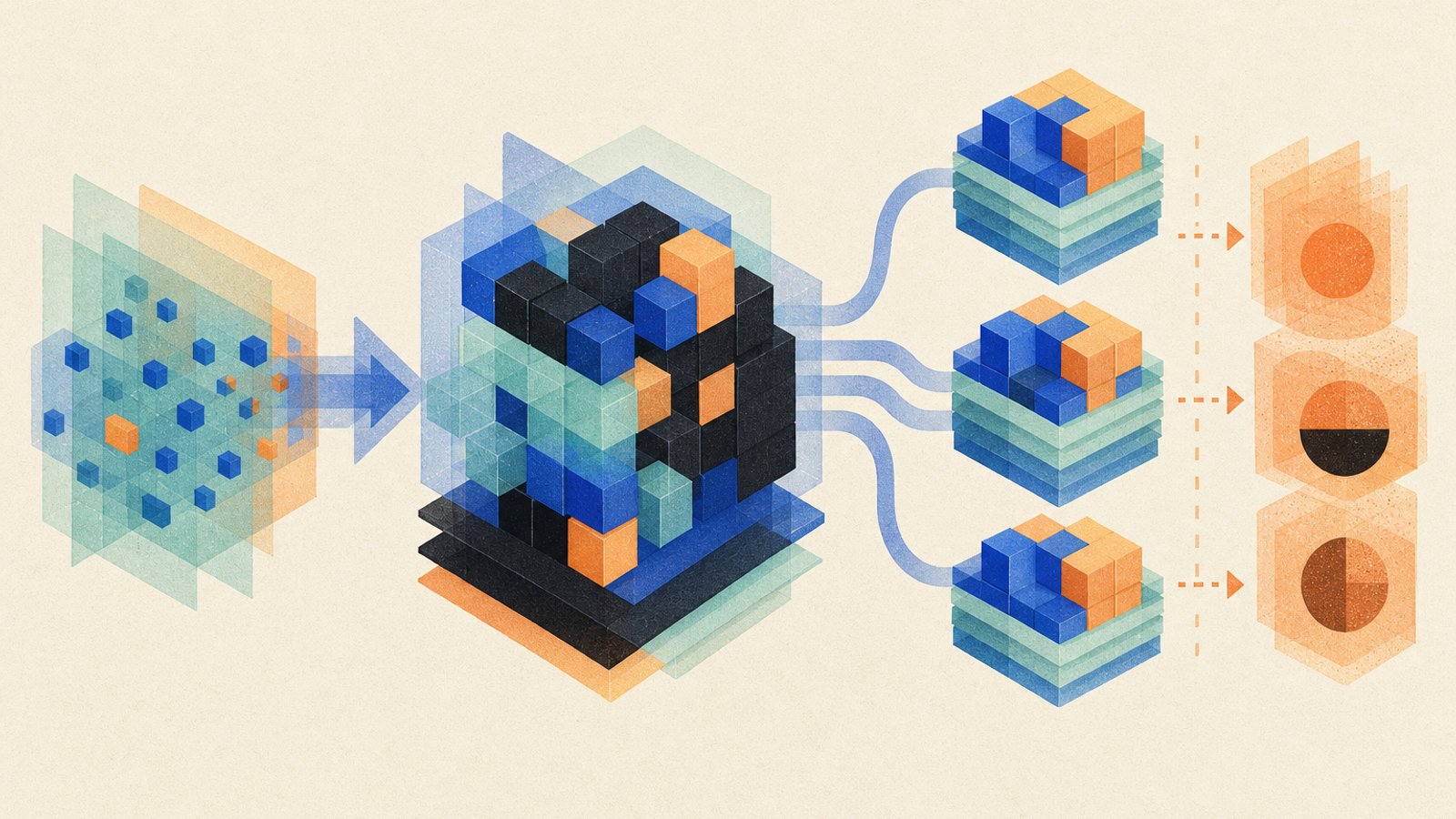
Qwen’s Hugging Face card records an FP8 version of its post-trained Qwen3.8-2.4T-A95B language model, packaged for Transformers. The publisher names vLLM, SGLang and TokenSpeed as serving options, while also documenting important constraints: this checkpoint is text-only, requires thinking mode, and cannot have thinking disabled. [1]
01
02
Repository format recorded by Qwen
The publisher says the repository contains FP8-quantized weights and configuration files in Hugging Face Transformers format.Model scale stated in the card
Qwen lists 2.4 trillion total parameters and 95 billion activated parameters.Native context stated in the card
Qwen records a native context length of 262,144 tokens and says it can be extended to 1,010,000.Input and reasoning limitation
The card describes the checkpoint as text-only and says thinking is required for every interaction.All technical characteristics shown are taken from Qwen's model card and are not independently benchmarked in the supplied evidence. [1]
03
What was published
The available primary record is Qwen’s own Hugging Face model card for Qwen3.8-2.4T-A95B-FP8. It establishes that Qwen has documented an FP8 checkpoint and its configuration in a public repository record. File completeness, download conditions and practical deployability are not independently established in the supplied material. [1]
- Qwen records that the repository holds FP8-quantized weights and configuration files for the post-trained Qwen3.8-2.4T-A95B model in Hugging Face Transformers format.
- The card identifies it as a causal language model with 2.4 trillion total parameters, 95 billion activated parameters, and a native 262,144-token context. Qwen says the context can be extended to 1,010,000 tokens.
- The repository registry entry was created on 8 August 2026; the retrieved card itself does not state a release date. [1]
04
Deployment path: documented options, not verified capacity
The card offers a deployment route through named serving frameworks, but it does not specify the accelerators, memory capacity, storage, parallelism, throughput or cost needed to run this 2.4T-parameter model. Teams should therefore treat framework support and relative FP8 performance as publisher-provided information to validate in their own environment. [1]
- Qwen lists vLLM, SGLang and TokenSpeed as compatible serving options and links recipes or documentation for those frameworks.
- The publisher says its fine-grained FP8 method uses a block size of 128 and claims metrics are nearly identical to the original model.
- Qwen advises using current framework versions and says inference efficiency and throughput vary substantially by framework. [1]
05
Use limitations and integration implications
The mandatory reasoning behavior is a material integration constraint. Applications should be prepared to receive and handle a reasoning portion before final content, rather than assuming a final-answer-only response format. The model card also presents suggested sampling settings, but these are recommendations from Qwen rather than independently established requirements. [1]
- Only text input is supported, according to the card; multimodal input is not supported.
- Thinking mode is mandatory for all interactions and cannot be disabled. The card says responses automatically begin with reasoning before the final output.
- Qwen documents three reasoning-effort settings: xhigh, medium and low. It says xhigh and preserve_thinking are enabled by default.
- The card notes that parameter support can vary by inference framework. [1]
06
Evidence boundary
Qwen’s card is the sole supplied primary source. It supports reporting what Qwen has published and stated about the checkpoint, but it does not independently prove claimed performance, operational compatibility, capacity requirements or access terms. [1]
- The model card and primary source are available at https://huggingface.co/Qwen/Qwen3.8-2.4T-A95B-FP8.
- Do not treat the card’s Qwen3.8-Max benchmark table as an independent evaluation of this FP8 checkpoint.
- Check the actual licence file and current repository access controls before operational use. [1]
07
What to check before deployment
The card provides a starting point for evaluation, but not a complete operating specification. [1]
- 01
Confirm repository access and artifact availability; the supplied record does not establish whether access is gated. [1]
- 02
Review the linked licence directly before use, especially for commercial or redistribution decisions; its terms were not included in the evidence. [1]
- 03
Validate the checkpoint on the intended framework and hardware. Qwen names vLLM, SGLang and TokenSpeed, but no independent compatibility test or resource requirement is supplied. [1]
- 04
Plan for text-only requests and retain the reasoning output path: the card says thinking is mandatory and cannot be disabled. [1]
08
Limits of this edition
The supplied primary evidence does not give hardware, memory, storage or throughput requirements. [1]
No independently controlled performance or framework-compatibility evaluation was supplied. Qwen’s statement that FP8 performance is nearly identical to the original model remains an attributed claim. [1]
The licence text was not included, so permissions, restrictions and commercial-use terms cannot be confirmed from this packet. [1]
The card’s benchmark table reports results for Qwen3.8-Max, not necessarily this FP8 repository; the supplied evidence does not establish direct transfer of those results. [1]
Repository availability conditions, including possible gating or approval requirements, are not established by the supplied evidence. [1]
SRC
Source desk
Direct links to the material behind this selection. Seeing the source matters as much as reading the synthesis.
Keep exploring

27 Aug 2026
Qwen3.8-Flash-Next: what its model card documents, and the limits to note
Qwen documents an experimental open-weight multimodal checkpoint with a 262,144-token native context limit and an optional YaRN path to longer contexts. Developers should verify framework behavior, account for default thinking output, and avoid treating publisher-reported benchmarks or long-context performance as independently established. [1]
2 Sept 2026
DeepSeek documents experimental vision model with reference inference and serving examples
DeepSeek’s model card documents an experimental image-and-text model repository with prompt-encoding tools, minimal PyTorch inference and example vLLM and SGLang serving paths. Its capability and benchmark statements are vendor-reported, while access conditions, full resource requirements and operational limits remain unestablished in the supplied evidence.
30 Sept 2026
Qwen documents Qwen-Image-2.1 image-generation and editing checkpoint
Qwen’s model card presents Qwen-Image-2.1 as a Diffusers-compatible image-generation and editing checkpoint with examples for text-to-image, input-image editing, and transparent RGBA creation. Its documented setup installs Diffusers from the Hugging Face GitHub repository. The card lists a 7B visual-generation component, while claimed quality and efficiency have not been independently assessed in the supplied evidence.