Qwen3.8-Flash-Next: what its model card documents, and the limits to note
Qwen documents an experimental open-weight multimodal checkpoint with a 262,144-token native context limit and an optional YaRN path to longer contexts. Developers should verify framework behavior, account for default thinking output, and avoid treating publisher-reported benchmarks or long-context performance as independently established. [1]
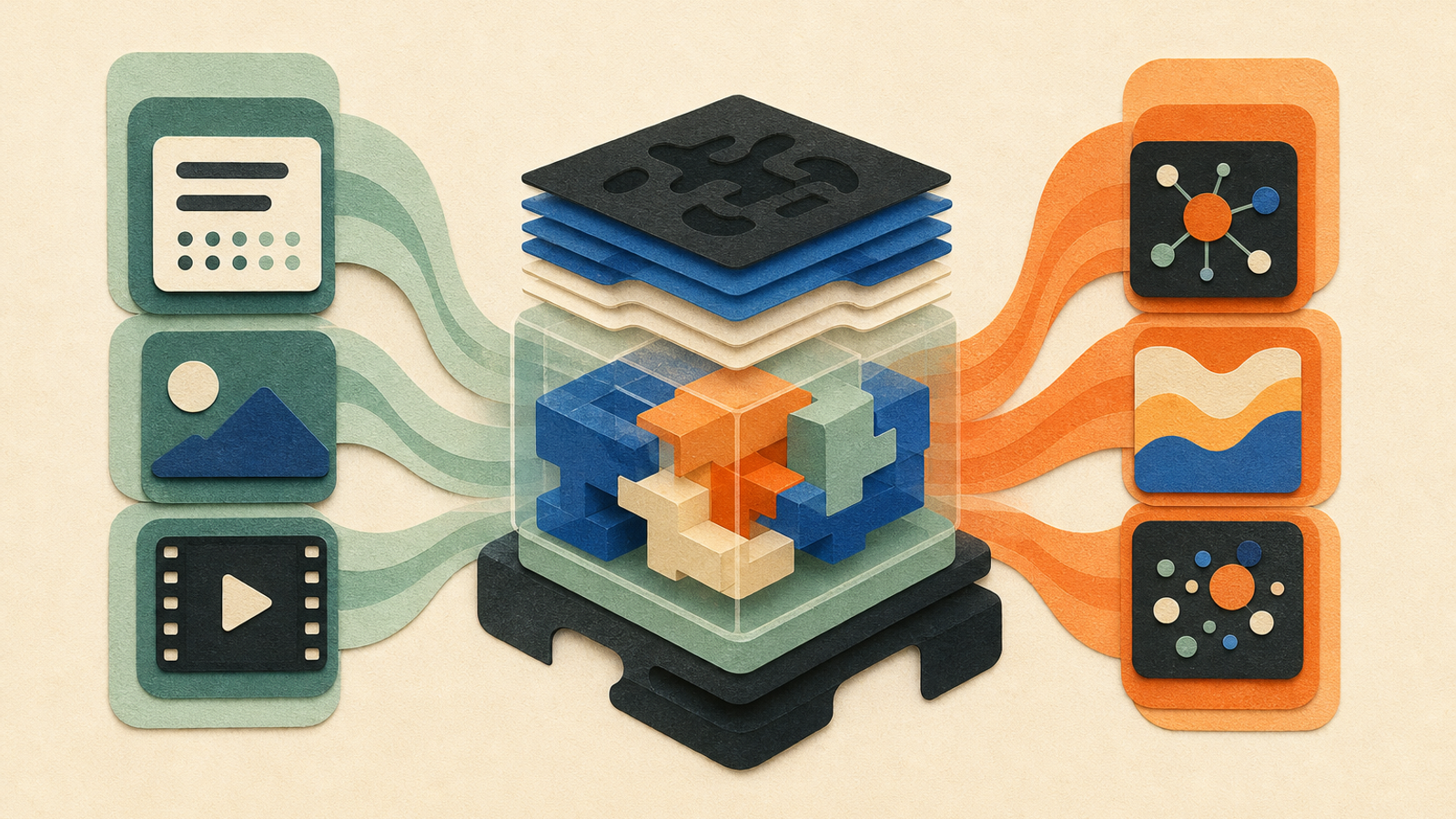
Qwen has published Qwen3.8-Flash-Next as an experimental open-weight checkpoint repository. Its model card documents text, image and video chat inputs, a 262,144-token native context window, and deployment guidance for several inference stacks, while leaving practical hardware needs, license terms and independent performance validation unresolved. [1]
01
What we know now
- 01
[1] Qwen official Hugging Face model card and repository record, retrieved August 26, 2026: https://huggingface.co/Qwen/Qwen3.8-Flash-Next (primary source).
- 02
[1] The repository record identifies an August 24, 2026 creation timestamp; the model card's citation block identifies August 2026 but does not provide a separate publication date.
02
Model form recorded by the publisher
The repository describes a causal language model with a vision encoder and weights in Hugging Face Transformers format. [1]Native context length
Qwen lists 262,144 tokens as the native context length. [1]Documented extension target
The card gives a YaRN configuration example for up to one million tokens, but this is not the native limit. [1]Default response behavior
Thinking mode is enabled by default according to Qwen's API guidance. [1]All technical details are publisher documentation and have not been independently tested in the supplied material. [1]
03
Release and documented scope
The official repository was created on August 24, 2026, and Qwen describes Qwen3.8-Flash-Next as an experimental preview. The publisher characterizes it as an open-weight release; the supplied record does not independently verify file availability, completeness or runtime behavior. [1]
Qwen's chat-completions examples show text-only, image and video inputs. That establishes documented intended input formats, not independent multimodal testing. [1]
- Qwen records 125B parameters, with 6B activated parameters, plus a 51B n-gram embedding and 4B MTP.
- The stated model type is a causal language model with a vision encoder.
- The repository includes model weights and configuration files in Hugging Face Transformers format.
04
Serving considerations
Developers should not assume an example works unchanged across servers. Qwen explicitly says parameter support varies by inference framework and recommends using current framework releases, without naming precise versions in the supplied evidence. [1]
The documented API behavior matters for integration: thinking is on by default. Qwen documents enable_thinking, preserve_thinking and reasoning_effort controls, plus a non-thinking configuration. Its examples indicate that the placement of thinking controls differs for Qwen Cloud versus the shown general chat-template configuration. [1]
- The model card lists Hugging Face Transformers, vLLM, SGLang and TokenSpeed as compatible options.
- Qwen says throughput and inference efficiency can differ substantially among frameworks.
- For higher-throughput use, the card recommends dedicated serving engines, but that is publisher guidance rather than an independent deployment result.
05
Long-context and video caveats
The one-million-token figure is a documented extension recipe, not the checkpoint's native context length. Qwen says the total length includes input and output and advises modifying RoPE parameters only when long contexts are needed. [1]
For video, the card documents an optional larger longest-edge setting intended to enable higher frame-rate sampling for hour-scale clips. This is configuration guidance from Qwen, not evidence of a verified quality or cost outcome, and developers should measure the effect in their own stack. [1]
- Native context is stated as 262,144 tokens.
- The YaRN example uses a factor of 4.0 to target 1,000,000 tokens.
- Qwen warns that static YaRN scaling may reduce performance on shorter text.
- The card suggests changing the scale factor for an application's typical context length rather than treating one million tokens as a universal setting.
06
Performance claims remain attributed
Qwen reports benchmark results and architectural advantages in the model card, including claims related to long-context latency and efficiency. These should be read as publisher claims. The supplied evidence provides no independent reproduction, controlled comparison or validation of those results. [1]
- Benchmark tables include language, coding, agent and vision-language tasks.
- Some listed evaluations use Qwen-described harnesses, prompts, judge models or corrected benchmark tasks.
- Some benchmarks are identified in the card as in-house.
07
Deployment checklist
Before adopting the checkpoint, validate the documented configuration in the exact serving stack you plan to use. [1]
- 01
Treat 262,144 tokens as the stated native context limit. Use the documented YaRN configuration only when longer contexts are required, and test short-context quality after enabling it. [1]
- 02
Confirm framework-specific support for sampling controls, thinking controls and multimodal processing; Qwen notes that support varies by framework. [1]
- 03
Account for thinking mode being enabled by default, including whether retained reasoning blocks are appropriate for multi-turn conversations. [1]
- 04
Test video preprocessing settings separately. The card says its conservative default is intended to favor text and image inference efficiency, while higher video settings are documented for hour-scale video use. [1]
- 05
Do not treat the model card's benchmark tables as independently validated performance evidence. [1]
08
Limits of this edition
The supplied evidence does not state hardware, memory, quantization or serving-cost requirements. [1]
The referenced qwen-community-1.0 license is named in the model card, but its terms are not included in the supplied evidence. [1]
The card recommends current versions of listed frameworks but does not specify compatible version numbers; the supplied material does not independently establish that each stack works with this checkpoint. [1]
Benchmark scores and claimed comparisons are reported by Qwen, with its own evaluation choices and some in-house benchmarks; no independent replication was supplied. [1]
SRC
Source desk
Direct links to the material behind this selection. Seeing the source matters as much as reading the synthesis.
Keep exploring
1 Oct 2026
DeepSeek-AI model card details V4.1-Flash context, cache and prompt tooling
DeepSeek-AI’s model card describes DeepSeek-V4.1-Flash as a multimodal model with a claimed one-million-token context limit and a reported 890-byte-per-token global KV-cache footprint. This release does not include a Jinja chat template; it points instead to reference prompt-encoding tools and local-inference instructions. The publisher recommends temperature 1.0, top_p of 0.95 or 1.0, a 1M-token context window and max_tokens of at least 256K, while performance and efficiency claims remain unverified by independent evidence. [1]
26 Aug 2026
Qwen documents FP8 Qwen3.8-2.4T-A95B checkpoint and mandatory reasoning mode
Qwen’s model card documents an FP8 Transformers-format checkpoint for Qwen3.8-2.4T-A95B, with named serving options and mandatory thinking-mode behavior. It does not provide the resource requirements, licence terms, access conditions or independent tests needed to confirm production readiness. [1]
30 Sept 2026
Qwen documents Qwen-Image-2.1 image-generation and editing checkpoint
Qwen’s model card presents Qwen-Image-2.1 as a Diffusers-compatible image-generation and editing checkpoint with examples for text-to-image, input-image editing, and transparent RGBA creation. Its documented setup installs Diffusers from the Hugging Face GitHub repository. The card lists a 7B visual-generation component, while claimed quality and efficiency have not been independently assessed in the supplied evidence.