AD-WM preprint argues for action-aware world models in MPC
The authors of the AD-WM preprint argue that counterfactual MPC needs latent models that preserve action-dependent distinctions. Their reported experiments associate the approach with higher success in selected simulation and Franka tests, but the evidence is limited to a preprint whose peer-review status is not established in the supplied record and does not establish broader performance.
This edition passed Imananq's enhanced publication checks. Some material claims remain explicitly attributed to official or company sources because no independent source is currently bound to this edition. The engine continues checking approved sources and will add corroboration only through a new edition that passes the full gate.

An arXiv preprint argues that latent world models used for counterfactual model-predictive control should retain distinctions between candidate actions, rather than be judged by factual prediction accuracy alone. Its experiments are author-reported, and the supplied record does not establish peer-review status or independent assessment. [1]
01
02
Reported hard-start success on OGBench-Cube
The authors compare AD-WM with a matched LeWM baseline in their reported experiment.Reported simulated environments with higher mean success
The authors report improvement over their reproduced baseline in four of five simulation environments.Reported Franka pick-and-place success
In the authors' named zero-shot setup, using a frozen V-JEPA 2 encoder and matched DROID post-training.All performance figures are author-reported results from a preprint whose peer-review status is not established in the supplied record.
03
What the authors introduced
Jiabin Qiu, Zixuan Chen, Hongye Cao, Jieqi Shi, Jing Huo and Yang Gao submitted version 1 of “AD-WM: Action-Discriminative World Models for Counterfactual Model Predictive Control” to arXiv on 24 September 2026. The record establishes that it is a preprint, but does not establish whether it has undergone peer review or independently validate its methods or conclusions.
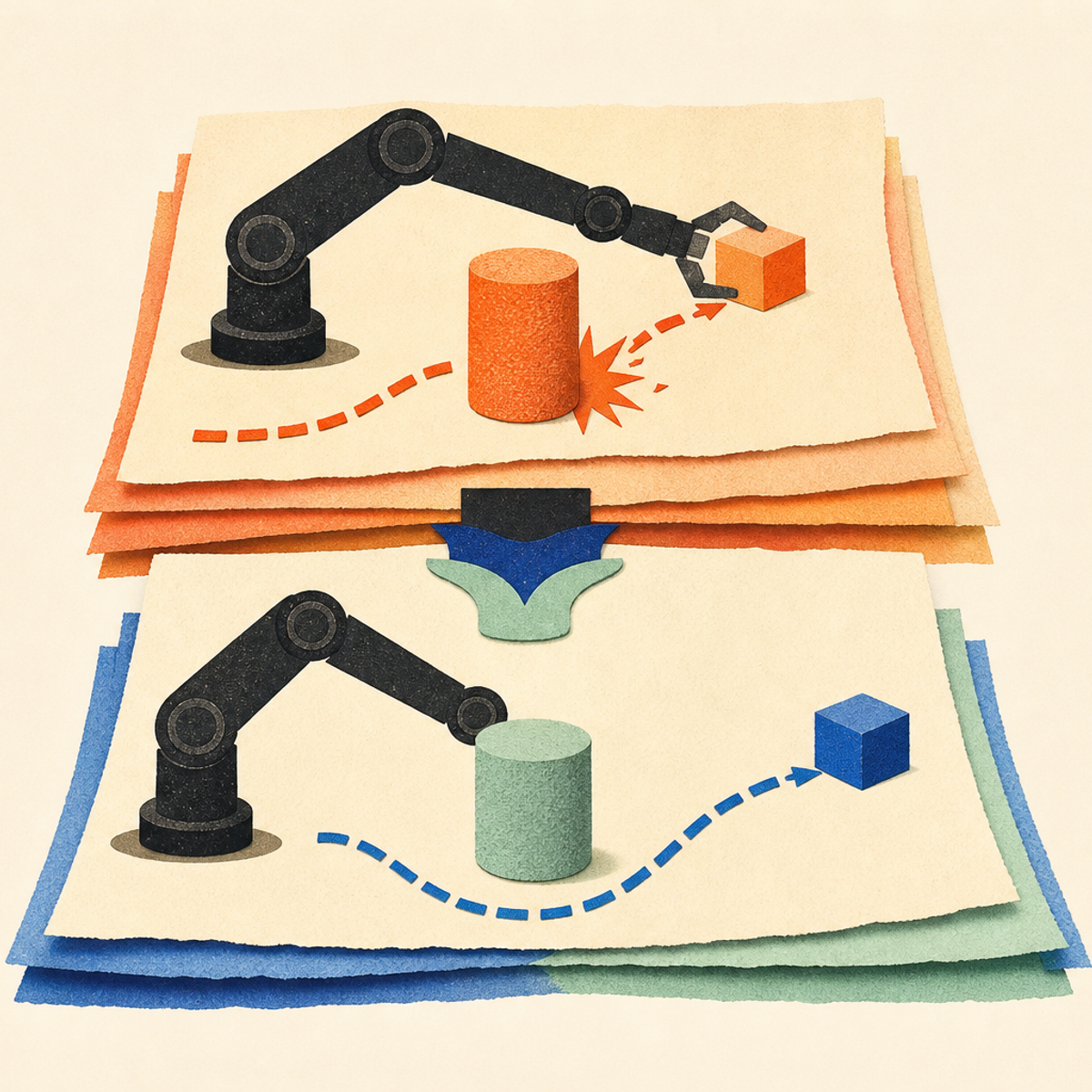
The authors frame a planning-specific problem: model-predictive control must compare alternatives from the same state, while a model trained on factual transitions can still fail to distinguish those alternatives. Their proposed remedy is to make the latent model more action-discriminative.
- AD-WM combines residual latent dynamics with predictor-level action-recovery regularization.
- The authors describe inverse dynamics and a normalized recovery objective as mechanisms intended to preserve action information in planning transitions.
- They say the auxiliary action-recovery heads are removed at test time, leaving the MPC procedure itself unchanged.
04
What the reported results suggest
The authors say their diagnostics did not place factual prediction error or whole-bank action ranking in the same order as closed-loop success. They report that CEM-aligned elite regret tracked closed-loop success more closely in their experiments.
Taken narrowly, the reported findings suggest that evaluation for counterfactual MPC may need measures tied to the controller's action choices, not only measures of factual transition prediction. This is the authors' interpretation, not an established general rule for world-model systems.
- On OGBench-Cube, the authors report hard-start success rising from 3.7% for a matched LeWM baseline to 52.0% for AD-WM.
- They also report higher mean success than their reproduced baseline in four of five simulation environments.
- For a Franka pick-and-place setup, they report zero-shot success rising from 42.2% to 71.1% with a frozen V-JEPA 2 encoder and matched DROID post-training, without lab-specific adaptation.
05
How to read the claim
For AI and robotics readers, the practical question raised by the preprint is whether a model retains the action-dependent differences a controller needs when it considers alternatives. The reported gains are limited to the authors' selected tests and should not be generalized without fuller evidence.
The primary source is the arXiv record: https://arxiv.org/abs/2609.30264v1
- The available evidence does not establish whether the work has been peer reviewed.
- No external replication or broader comparative assessment is included.
- The supplied abstract does not provide enough detail to assess experimental design, variance, failure modes, or implementation trade-offs.
06
What to take from the preprint
Treat the reported results as a research signal to examine, not as independently validated deployment guidance.
- 01
Read the primary arXiv record and check later versions or other sources for any review-status information before relying on the findings.
- 02
When assessing a planning world model, compare action-selection quality under the intended controller as well as factual prediction error.
- 03
Do not infer performance on other robots, tasks, or production settings from the reported OGBench-Cube and Franka results.
07
Limits of this edition
The supplied primary evidence is an arXiv abstract page, not an assessment of the complete paper, protocols, code, or data. [1]
The record does not establish peer-review status, independent replication, statistical uncertainty, failure cases, or results beyond the reported baselines and setups. [1]
Reported results on the named simulation tasks and Franka setup do not establish performance on other hardware, environments, or deployments. [1]
SRC
Source desk
Direct links to the material behind this selection. Seeing the source matters as much as reading the synthesis.
Keep exploring

24 Sept 2026
Preprint proposes language-guided robot group joining
An arXiv preprint proposes identifying a verbally described group in a scene and predicting a robot pose for joining it. Its authors report experiments, sub-second inference, baseline improvements for pose prediction, and real-robot demonstrations, but the supplied record lacks detailed metrics, protocols, safety evaluation, and independent verification.
18 Sept 2026
Preprint describes obstacle-collision failures in coding-agent robot tasks
A version 1 arXiv preprint reports that an evaluated coding agent collided in most cases with obstacles it was instructed not to touch while pursuing manipulation goals. The authors attribute this to planning that did not prioritize the obstacle constraint and propose SafeHarness, combining obstacle-aware route planning with obstacle-aware contact execution. Its reported performance figures, including 71.9% task success and 87.5% collision avoidance, remain limited by missing evaluation details and the lack of independent verification in the supplied record.
1 Sept 2026
Aero Hand Open preprint describes a simulation-ready tendon-driven hand
The Aero Hand Open preprint says it releases a tendon-driven hand design alongside simulation, actuation-mapping, reinforcement-learning, and deployment resources. Its reported no-fine-tuning deployment workflow has not been independently verified in the supplied evidence.