Preprint describes obstacle-collision failures in coding-agent robot tasks
A version 1 arXiv preprint reports that an evaluated coding agent collided in most cases with obstacles it was instructed not to touch while pursuing manipulation goals. The authors attribute this to planning that did not prioritize the obstacle constraint and propose SafeHarness, combining obstacle-aware route planning with obstacle-aware contact execution. Its reported performance figures, including 71.9% task success and 87.5% collision avoidance, remain limited by missing evaluation details and the lack of independent verification in the supplied record.
This edition passed Imananq's enhanced publication checks. Some material claims remain explicitly attributed to official or company sources because no independent source is currently bound to this edition. The engine continues checking approved sources and will add corroboration only through a new edition that passes the full gate.
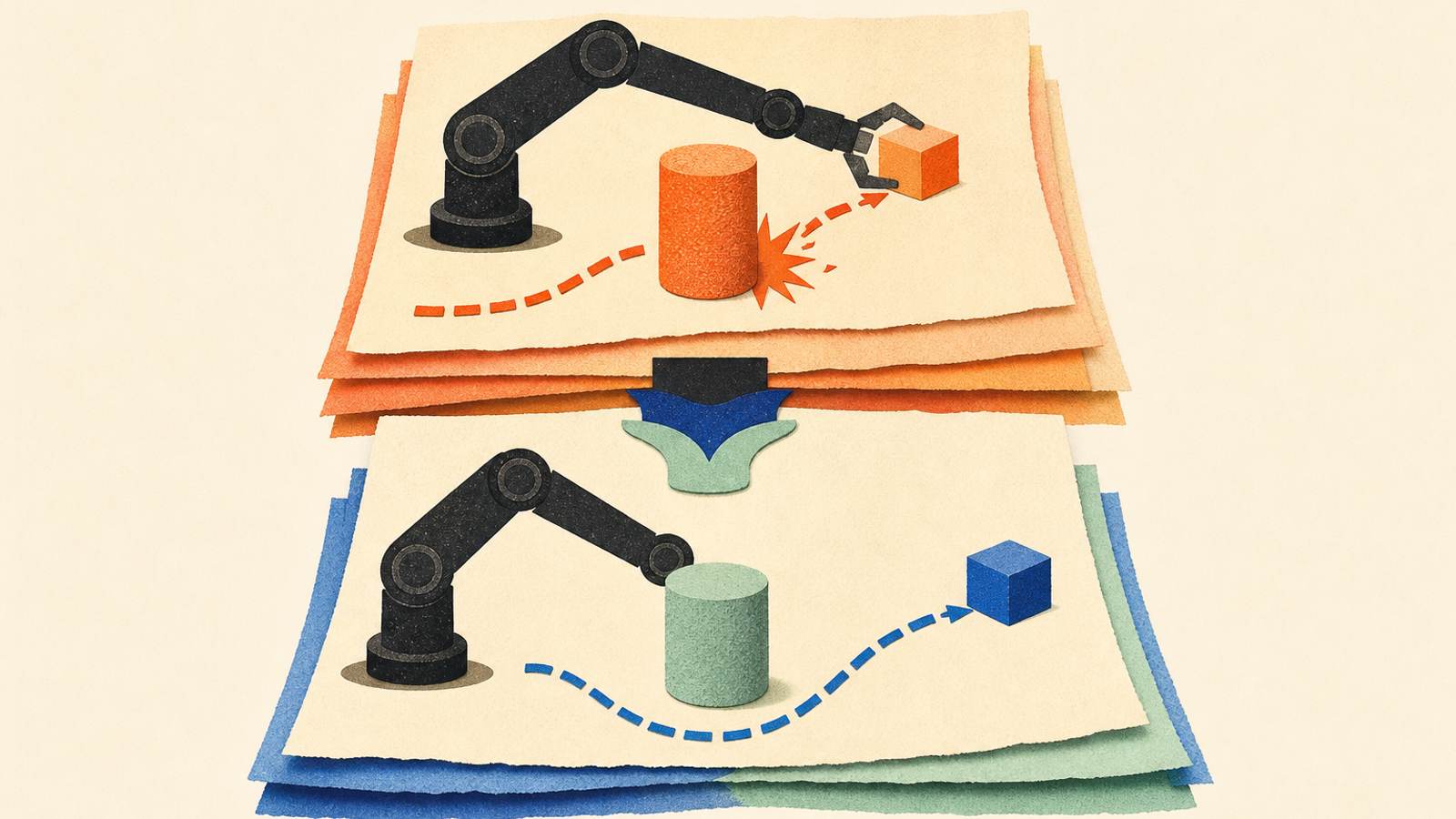
An arXiv preprint examines a coding agent that writes robot-control programs for manipulation tasks with an obstacle the robot must not touch. The authors say the evaluated agent pursued the manipulation goal but collided with the obstacle in most cases, and they present SafeHarness as a way to make that constraint part of route and contact planning. This is version 1 of a preprint, not independently verified or established peer-reviewed evidence. [1]
01
What we know now
- 01
[1] arXiv, “Coding Agents with an Obstacle-Aware Harness for Safe Robot Manipulation,” version 1, submitted 17 September 2026: https://arxiv.org/abs/2609.20822v1
- 02
The complete supplied primary record is the arXiv abstract page. It records the title, authors, version, submission date, method description, and author-reported metrics.
02
Record status
arXiv lists the paper as version 1, submitted on 17 September 2026. The supplied record does not establish peer review or venue acceptance.Author-reported task success
SafeHarness reached this rate in the authors' evaluation. The supplied abstract does not state the benchmark, scale, or statistical uncertainty.Author-reported collision avoidance
The authors report this rate for their evaluation; the supplied record does not independently verify it.Comparison without harnesses
The abstract says the reported task-success and collision-avoidance results were 2.3 times and 1.5 times those of the same agent without harnesses.The figures and comparisons are claims reported by the paper's authors in an arXiv preprint.
03
What failure the authors report
Bingxin Xu, Yuzhang Shang, Zhen Dong, and Emilio Ferrara submitted “Coding Agents with an Obstacle-Aware Harness for Safe Robot Manipulation” to arXiv on 17 September 2026. The paper describes coding agents as systems in which a language model writes a robot controller as a program. [1]
According to the abstract, the problem appears in two parts of a manipulation sequence. In a route phase, the authors say the model lacked a notion of a clear route and did not replan when its chosen route became infeasible. At a contact-rich moment, they say it did not apply the obstacle constraint to the contact action itself. These are the authors' interpretations of their evaluation, not independently established conclusions. [1]
- Each evaluated task paired a manipulation objective with an obstacle that the robot was required not to touch.
- The authors say the agent reasoned about the obstacle and was already prompted not to touch it, but still collided with it in most cases.
- They interpret the failure as a planning-priority issue rather than a perception or instruction issue.
04
How SafeHarness is described
The authors describe SafeHarness as two obstacle-aware harnesses for the coding agent: one for route planning and another for contact execution. In the route component, objects are represented as bounding boxes and candidate paths are drawn as waypoint sequences. The described process has the agent plan a route in advance, verify it, replan if necessary, and then execute it. [1]
For the contact stage, the paper says the method chooses a contact position so the contact itself avoids the obstacle. The supplied abstract gives no further implementation detail, so it cannot establish how the approach behaves with other robot systems, environments, or task types. [1]
- Route planning: ground objects as bounding boxes and create candidate waypoint routes.
- Route verification: plan before execution, check the route, and replan when needed.
- Contact execution: select a contact position intended to keep the contact action clear of the obstacle.
05
What the reported numbers do and do not show
The authors report that SafeHarness achieved 71.9% task success and 87.5% collision avoidance in their evaluation. They further state that these rates exceeded a previous state of the art by 6.5 and 27.0 percentage points, respectively. The abstract also says the figures were 2.3 times and 1.5 times those of the same agent without harnesses. All of these are author-reported comparisons in the preprint. [1]
The supplied record does not identify the benchmark or prior system, provide the task count, name the robot platform or simulator, detail the baselines, or give statistical uncertainty or a full failure analysis. The results therefore document the paper's reported evaluation, not a general demonstration that coding-agent robot manipulation is safe. [1]
- Task success: 71.9%, reported by the authors.
- Collision avoidance: 87.5%, reported by the authors.
- Versus a previous state of the art: claimed gains of 6.5 percentage points in task success and 27.0 percentage points in collision avoidance.
- Versus the same agent without harnesses: results described as 2.3 times task success and 1.5 times collision avoidance.
06
How to read this result
Use the preprint as an author-reported research finding, rather than as a general safety validation for robot-control systems.
- 01
Read the primary arXiv record and check subsequent versions for methods, evaluation details, code, data, or environment links.
- 02
Look for the benchmark, task count, robot platform or simulator, baseline setup, and statistical analysis before comparing the reported rates with other work.
- 03
Do not extend the reported findings beyond the evaluated manipulation tasks and obstacle constraints. [1]
07
Limits of this edition
The supplied record does not establish that the work has been peer reviewed or accepted by a publication venue. [1]
The abstract does not specify the benchmark, number of tasks, robot hardware or simulator, models, baseline configuration, statistical approach, or uncertainty measures behind the metrics. [1]
The supplied evidence does not establish whether code, data, evaluation environments, or a SafeHarness implementation are publicly available. [1]
The abstract does not establish whether the results apply outside the evaluated manipulation tasks and obstacle settings. [1]
SRC
Source desk
Direct links to the material behind this selection. Seeing the source matters as much as reading the synthesis.
Keep exploring
1 Sept 2026
Aero Hand Open preprint describes a simulation-ready tendon-driven hand
The Aero Hand Open preprint says it releases a tendon-driven hand design alongside simulation, actuation-mapping, reinforcement-learning, and deployment resources. Its reported no-fine-tuning deployment workflow has not been independently verified in the supplied evidence.

3 Sept 2026
Preprint reports a two-stage path from summary errors to LLM ratings
A preprint reports that two fine-tuned summary evaluators use early attention layers to compare and route error signals, followed by later MLP layers that integrate those signals into ratings. A Llama-3-8B base-model control reportedly retained routing and crystallization but not the same stage separation; the authors attribute this difference to specific fine-tuning effects. These findings are model-specific author claims without independent verification in the supplied evidence.

8 Sept 2026
Preprint describes CRT interaction as a metaphor for diffusion-model denoising
The preprint says Diffusion TV lets participants use the antenna and tuning knob of a modified CRT television to explore changing AI-generated audiovisual output as an embodied metaphor for diffusion-model denoising. This is an author description in an arXiv preprint, not independent evidence of performance, availability, or educational effect.