Preprint proposes test-time adaptation by revising an AI agent’s workflow
The authors of a new arXiv preprint propose “harness learning”: training a model to revise the executable workflow around a language-model agent from execution feedback. They report gains on reasoning and multi-hop question-answering tasks and transfer to unseen tasks, but the supplied evidence contains no scores, baselines, code, peer review or independent replication.
This edition passed Imananq's enhanced publication checks. Some material claims remain explicitly attributed to official or company sources because no independent source is currently bound to this edition. The engine continues checking approved sources and will add corroboration only through a new edition that passes the full gate.

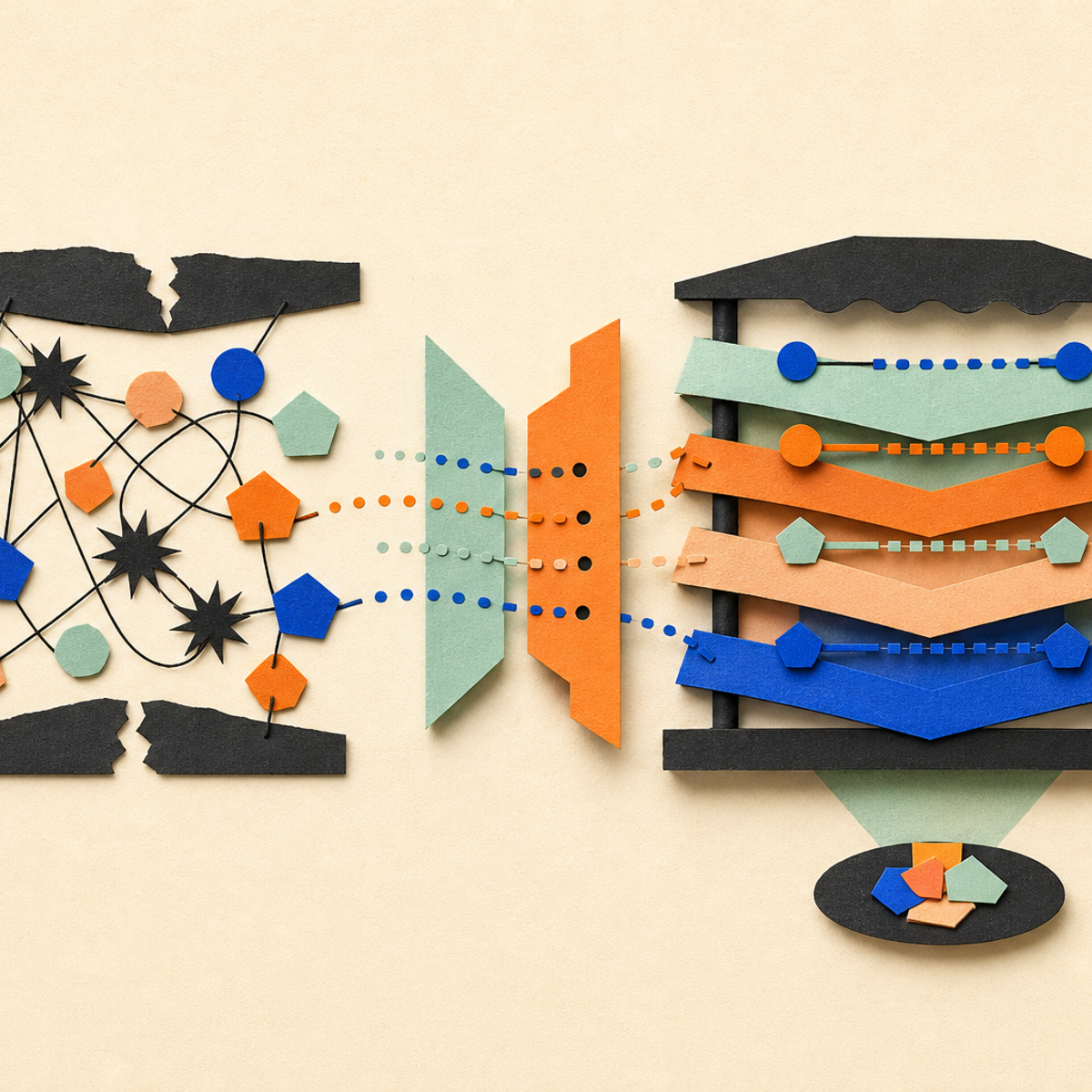
A newly submitted arXiv preprint presents “harness learning,” a proposed way for a language-model agent to adapt at test time by revising its executable workflow instead of updating the model’s parameters. The paper’s authors say the workflow, or harness, organizes model calls, tool use and information flow. [1]
01
What we know now
- 01
[1] arXiv primary record, “Harness Learning Enables Generalizable Test-Time Adaptation,” submitted 28 September 2026: https://arxiv.org/abs/2609.35738v1.
- 02
The complete supplied primary record is limited to the arXiv page and abstract; it establishes the preprint listing and preserves the authors' method and experiment descriptions as attributed claims.
02
What is revised during adaptation
The authors describe revising the executable harness that coordinates model calls, tool use and information flow.What remains unchanged at test time
The abstract says refinement occurs without a parameter-space update.Reported evaluation areas
The authors report experiments on reasoning and multi-hop question answering.A high-level distinction described in the authors' abstract, not an independent performance assessment. [1]
03
What the paper introduces
The authors propose training a separate proposer model to alter a solver agent’s harness using feedback from task executions. They characterize this as meta-learning over executable programs: harness revisions take the role that weight updates have in gradient-based adaptation. [1]
- The preprint is titled “Harness Learning Enables Generalizable Test-Time Adaptation” and is listed on arXiv with Alvin Zhang and eight coauthors. [1]
- It frames a language-model agent as both a model and an executable harness. In the authors’ description, the harness determines how model calls, tools and information are organized. [1]
04
What changes at test time
This is a workflow-level adaptation proposal. Rather than claiming that the underlying language model learns new weights during a task, the authors describe altering the program around it: the sequence and arrangement of calls, tools and information flow. The supplied record does not explain the implementation details needed to assess how this would work in a production system. [1]
- The authors say the proposer is trained with reinforcement learning, using performance of revised harnesses on tasks as the reward. [1]
- At test time, they say the proposer can use feedback from successive runs on a new task to refine the harness without a parameter-space update. [1]
- The abstract says policies trained on single revisions may continue improving a harness over multiple rounds, while the value of training on revision sequences differs by setting. [1]
05
What the evidence supports, and what it does not
Those results are author-reported claims in the abstract. The supplied primary record does not provide the numerical results, comparison methods, statistical detail or failure cases needed to judge the size or reliability of the reported effects. It also does not establish independent evaluation or replication. [1]
06
Why this is worth watching
For readers following AI-agent research, the paper identifies a distinct design question: whether an agent can become more effective on a new task by changing its executable orchestration rather than its model parameters. That is a research direction, not yet a demonstrated general capability on the supplied evidence. The primary source is the arXiv record linked in the evidence below. [1]
- Primary record: arXiv, “Harness Learning Enables Generalizable Test-Time Adaptation.” [1]
07
How to read the preprint
Treat the work as an early research claim rather than a validated deployment method.
- 01
Read the primary arXiv record and, if evaluating the approach, inspect the full paper for benchmarks, baselines, costs and failure cases.
- 02
Do not infer peer review, reproducibility, public code or broad effectiveness from the abstract alone.
- 03
Distinguish changes to an agent's executable workflow from changes to the underlying model parameters.
08
Limits of this edition
This is an arXiv preprint submitted on 28 September 2026, not evidence of peer review. [1]
The supplied record contains no benchmark scores, baselines, statistical analysis, compute costs, failure cases or independent replication. [1]
The available evidence does not establish public source code, datasets or other experimental artifacts. [1]
SRC
Source desk
Direct links to the material behind this selection. Seeing the source matters as much as reading the synthesis.
Keep exploring
16 Sept 2026
Preprint proposes a “social harness” for multi-agent AI interactions
The authors of a September 2026 arXiv preprint argue that multi-agent AI systems need a “social harness” for interactions among agents, alongside each agent's personal harness. They report experiments suggesting current tools can fail across trust boundaries and propose layers for prevention, runtime message checks, and later investigation. The available evidence is limited to the preprint record and abstract. [1]

16 Sept 2026
A preprint’s case for AI that helps shape research questions
The preprint proposes a framework for AI that helps revise the course of research itself, rather than only answering questions or operating tools within a predefined task. It is an authors’ proposal in a newly submitted arXiv preprint, not evidence of peer-reviewed or independently verified capability.

15 Sept 2026
Nuha-Speech: what an Arabic speech-LLM preprint reports, and what is not yet known
Nuha-Speech is an arXiv preprint describing an Arabic speech-LLM research initiative. Its authors report a speech question-answering corpus with more than 1.5 million training samples, supervised fine-tuning of Qwen-Omni variants, and an evaluation framework. The available primary record does not establish peer review, public release of materials, performance results, or independent replication.