RAPID proposes turning one visual human demonstration into a testable program
RAPID is an arXiv preprint whose authors propose automatically creating, testing, and refining robot programs from a single visual human demonstration. They report simulation and real-robot evaluations, including eight nonprehensile tasks, but the supplied record lacks metrics, baselines, peer review, replication, and detailed deployment constraints.
This edition passed Imananq's enhanced publication checks. Some material claims remain explicitly attributed to official or company sources because no independent source is currently bound to this edition. The engine continues checking approved sources and will add corroboration only through a new edition that passes the full gate.

A new arXiv preprint introduces RAPID, a proposed system for deriving a robot program from one visual human demonstration, then testing and refining it through an iterative loop. Its authors report simulation and physical-robot evaluations, but the supplied record provides neither peer review nor the metrics and comparisons needed to independently assess the results. [1]
01
What we know now
- 01
[1] arXiv, “RAPID: Robot Agentic Programming from Demonstrations,” version 1, submitted 24 September 2026. https://arxiv.org/abs/2609.30249v1.
- 02
The source is a complete primary arXiv record, but it is a preprint and does not itself establish peer review or independent validation.
02
Research record
The arXiv listing identifies this work as version 1 of a preprint submitted on 24 September 2026.Input described by authors
The proposed system starts from one visual human demonstration.Reported simulated tasks
The abstract says the authors evaluated eight contact-rich nonprehensile manipulation tasks in simulation.Reported physical platform
The authors say they deployed the method on a Franka robot arm for those eight tasks.All performance and evaluation statements shown here are author-reported in the preprint abstract, not independently validated.
03
What RAPID proposes
The paper, titled “RAPID: Robot Agentic Programming from Demonstrations,” was posted as arXiv version 1 on 24 September 2026 by Yuyao Liu, Jiayuan Mao, David Hsu, Leslie Pack Kaelbling, and Tomás Lozano-Pérez. The authors describe RAPID as a way to turn a single visual demonstration by a person into a robot program. [1]
According to the abstract, the system is intended to infer the components required for an execution-and-verification loop automatically, rather than requiring each component to be manually specified. The abstract alone does not provide enough implementation detail to evaluate how these inferences are made. [1]
- It proposes inferring a testable task specification from the demonstration.
- It also proposes deriving action primitives for execution and an interactive environment for running and checking the program.
- The authors describe an iterative process that generates, verifies, and refines the resulting robot code.
04
How reusability is meant to work
Rather than preserving only the exact motion shown in a demonstration, the authors say RAPID uses an object-centric relational representation. In their account, this focuses on relations between objects and the strategy’s underlying structure, which is intended to let a program be reused outside the original scene. [1]
This is a proposed technical design described by the authors. The supplied evidence does not provide detailed methods, tests of individual design choices, or independent confirmation that the representation improves reuse. [1]
- Object-level relations are intended to represent the structure of a demonstrated strategy.
- Action primitives are described as trajectory-optimization programs intended to create object-level motion effects.
- Scene-specific geometry is meant to be captured at run time through relational constraints.
05
What evidence the authors report
The abstract records evaluations in simulation and a deployment on a physical Franka arm. The authors say their experiments showed generalization under several changes to objects and environments. [1]
Those are author-reported findings. The supplied material does not give success rates, error measures, baseline methods, experimental protocols, or replication results, so it cannot establish the size, reliability, or scope of the claimed performance. [1]
- The authors report simulation experiments on eight contact-rich nonprehensile manipulation tasks.
- They also report evaluation on the LIBERO-Pro benchmark for general prehensile manipulation.
- They say they deployed RAPID on a real Franka arm and evaluated all eight nonprehensile tasks.
- They report generalization across object pose, shape, material, and environment.
06
Why this matters and what remains open
For readers following robot learning and programming, RAPID frames one visual human demonstration as the starting point for a program that can be executed, checked, and revised. The central question is not only whether a robot can imitate a motion, but whether the demonstrated strategy can be expressed in a testable form that adapts to a new scene. [1]
The available record leaves important questions unanswered: whether the research has been peer reviewed; how it compares quantitatively with alternatives; what it fails on; what safety measures and human oversight the real-robot work used; and whether code, data, or task materials are available. The arXiv record is the primary source for the current claims: https://arxiv.org/abs/2609.30249v1. [1]
- The primary record is the arXiv entry for RAPID: arXiv:2609.30249v1.
- Readers should not infer availability of code, data, or a deployable system from the listing alone.
07
How to read the preprint
Treat RAPID as an early research claim rather than a deployment guide.
- 01
Read the primary record and, if needed, the full paper before relying on technical details not included in the abstract.
- 02
Separate the proposed architecture from the authors’ reported experimental outcomes.
- 03
Look for future peer review, code or data releases, independent replications, metrics, baselines, and documented failure cases.
08
Limits of this edition
This is an arXiv preprint, not evidence of peer review, acceptance, or independent replication. [1]
The supplied abstract does not include quantitative results, baseline comparisons, statistical methods, or detailed failure cases. [1]
The record does not establish whether implementation code, task code, or experimental data are public. [1]
Hardware setup, safety constraints, and the level of human intervention in the physical deployment are not specified in the supplied evidence. [1]
SRC
Source desk
Direct links to the material behind this selection. Seeing the source matters as much as reading the synthesis.
Keep exploring

26 Sept 2026
AD-WM preprint argues for action-aware world models in MPC
The authors of the AD-WM preprint argue that counterfactual MPC needs latent models that preserve action-dependent distinctions. Their reported experiments associate the approach with higher success in selected simulation and Franka tests, but the evidence is limited to a preprint whose peer-review status is not established in the supplied record and does not establish broader performance.

24 Sept 2026
Preprint proposes language-guided robot group joining
An arXiv preprint proposes identifying a verbally described group in a scene and predicting a robot pose for joining it. Its authors report experiments, sub-second inference, baseline improvements for pose prediction, and real-robot demonstrations, but the supplied record lacks detailed metrics, protocols, safety evaluation, and independent verification.
18 Sept 2026
Preprint describes obstacle-collision failures in coding-agent robot tasks
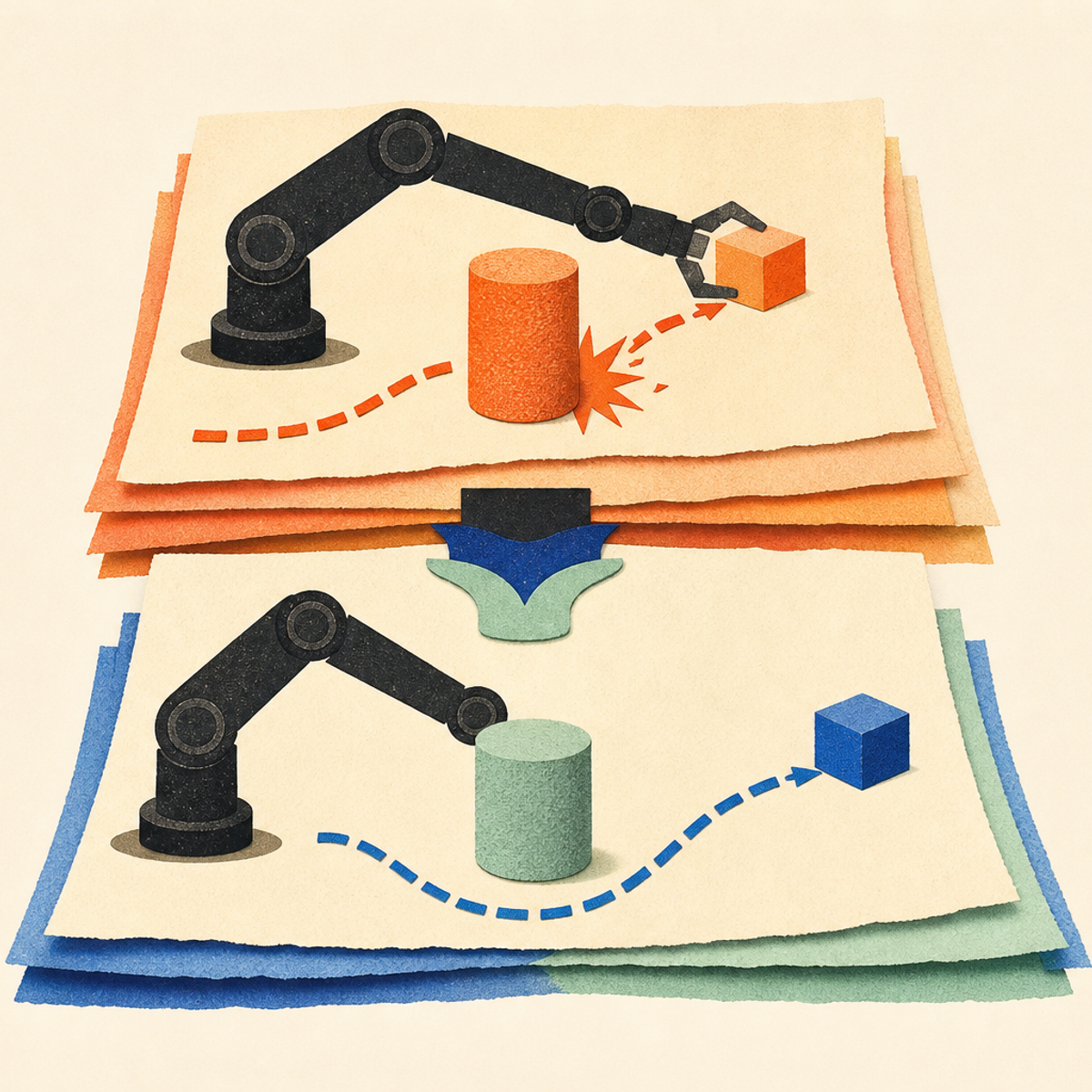
A version 1 arXiv preprint reports that an evaluated coding agent collided in most cases with obstacles it was instructed not to touch while pursuing manipulation goals. The authors attribute this to planning that did not prioritize the obstacle constraint and propose SafeHarness, combining obstacle-aware route planning with obstacle-aware contact execution. Its reported performance figures, including 71.9% task success and 87.5% collision avoidance, remain limited by missing evaluation details and the lack of independent verification in the supplied record.